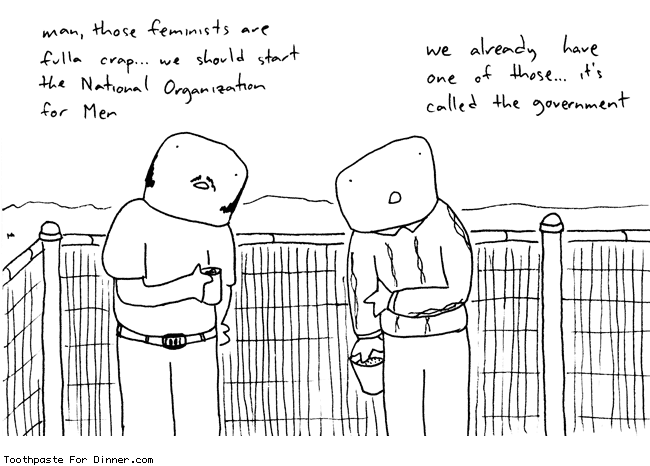
National Organization of Men
You must go see yesterday’s Toothpaste for Dinner comic.
Hat tip to Alexandra.
You must go see yesterday’s Toothpaste for Dinner comic.
Hat tip to Alexandra.
Last night I attended a talk held at the University of Windsor given by Dr. Shahnaz Khan. The topic of the presentation was entitled: Veil Talk: Examining the Many Facets. Dr. Khan is the author of Aversion and Desire; Negotiating Muslim Female Identity in the Diaspora and a professor in Global Studies and Women’s Studies at Wilfred Laurier University in Waterloo, Ontario.

As she was discussing how the veil takes many forms and waiting for some technology to catch up with the presentation she took questions from the audience. A man criticized her for confusing all these Westerners. He said that what she was showing the group were not in fact veils, that there was a difference between veils and head coverings. He told her that He Would Now Teach Her That Difference.
It was an unbelievably arrogant and dismissive comment. Dr. Kahn is an expert in her field. She has written and lectured on this topic for many years. She had just finished describing and showing pictures of some of the many ways women veil and explaining that where a woman lives has much to do with the form the veil takes and that there are many reasons why a woman veils. She showed pictures of hijab, niqab, burka, obaya and chador and as all are used to cover a woman’s body they come under the category of veiling. She discussed the relationship between veiling and class — in the past, veiling beyond a head covering for protection from the sun — worn by both men and women — was practiced by upper class women. Those involved in physical labour were unable to work effectively with their movement restricted. We were much too polite to him. Instead of telling him where to go we rolled our eyes at each other, grimaced, and groaned. The idea of waiting for one person to finish talking before speaking should have been replaced with heckles and boos.
A few minutes later another man criticized her for not taking the talk to a different level — that we need to go beyond the talk she gave. Her response was that his idea is a different talk than the one she gave — an idea for another day. Judging by the number of people in the room who turned up for her presentation I’d say there was an interest in the talk that was presented. Not to say there isn’t more to say — but we have to start somewhere.
The first man tried taking the floor a second time at the end of the presentation but the moderator cut him short with her closing remarks — several times. This man did not want to stop — he was determined to re-educate the group. Dr. Kahn handled it all beautifully. It looked as though she’d dealt with this before.
Some of us were saying that it was really wonderful that these men turned up to tell us how to talk about women’s bodies. Because, you know, how could women do that on their own?
I’ve known for years (almost 14 — the age of my oldest child) that breastmilk is the absolute best thing in the world. Now there’s one more reason why it’s awesome:
Breastmilk contains stem cells. Seriously. Check out that article.
flickr photo by Hoover Family Photos
Want to know what to do for your Valentine this year?
Call Kathleen Wynne, Ontario’s Minister of Education and ask when the already promised Women’s and Gender Studies course will be added into the Ontario Secondary School Curriculum.
Kathleen Wynne’s Office: 416.325.2600
TDD/TTY: 1-800-263-2892
Today, February 14th 2008, between 9 and 5, pick up the phone and help stop sexual harassment.
Touching, grabbing, gang-style rape. These are just some of the incidents revealed in the Falconer Report. Sexual and gender-based violence is reaching epidemic-levels.
According to the Canadian Centre for Addiction and Mental Health:
“four percent of males in grade 11 admitted trying to force someone to have sex with them, while 10 percent of males and 27 percent of females admitted being pressured into doing something sexual that they did not want to. Not surprisingly, the data shows that girls are feeling this pressure more than boys, with 15 percent reporting that they had oral sex just to avoid having intercourse.” Is this okay with you?
Here’s more from the Miss G_ Project for Equity in Education:
******
Please join us in our most crucial campaign yet!
“No More Miss Nice G__” is a phone calling campaign taking place on February 14, 2008. HAPPY VALENTINE’S DAY! We are asking all supporters of the project to call the Ministry of Education expressing that we cannot afford to wait any longer for a Women’s and Gender Studies course to be added into the Ontario Secondary School Curriculum.
**** Calling the Ministry of Education is absolutely not as stressful nor as intimidating as it may sound. In fact, you are a citizen and it is the Ministry’s job to listen to you and to take your calls.
PHONE #s:
Kathleen Wynne’s Office: 416.325.2600
TDD/TTY: 1-800-263-2892WHEN: between 9am - 5pm Thursday, February 14 (If that doesn’t work for you, anytime is better than never).
WHAT TO EXPECT: This number will take you directly to Kathleen’s office, where her assistant will either pick up, or you will be put through to her assistant’s voicemail. You can leave a personal message or voicemail recording for her assistant to pass on to Minister Wynne.
WHAT TO SAY: Identify who you are and where you are from. State that you are leaving a message for the Minister of Education, Kathleen Wynne, and express your support for a Women’s and Gender Studies course being implemented into the Ontario Secondary School Curriculum. Ask when Minister Wynne will honour her promises and policy-commitments to introduce WGS into the provincial curriculum. (There are more ideas for things to say below.)
—> Bonus points: Talk about a personal experience that proves to you why addressing this issue is so important and urgent.WHAT TO REMEMBER: You are fabulous and intelligent, you have an opinion, and your voice needs to be listened to!
If you have any questions or need any encouragement, do not hesitate to leave a post or to contact themissgproject@gmail.com.
*************************************
JUST THE FACTS MA’ME
(or, why would I want to do this anyway?)
*************************************FACT: The recently released “Falconer Report” found that sexual assault and sexual harassment are alarmingly prevalent in Toronto schools and the authors recommended that the Toronto District School Board should “develop a sexual assault and gender-based violence policy” and partner with community agencies to provide services for women and girls experience violence. (http://www.thestar.com/News/GTA/article/292869)
FACT: All students, regardless of their race, gender, sexual orientation, deserve to go to school in a safe environment. In fact, government policy guarantees “all students… a safe and secure environment so that they can participate fully and responsibly in the educational experience.”
FACT: In response to the Falconer report, Minister Wynne stated, “we know prevention is better than reaction,” and speaks frequently in support of “inclusive learning environments.”
FACT: A women’s and gender studies course in high schools — which the Miss G Project has been working with the government to implement for the last 3 years — would be one highly effective way of creating that inclusive learning environment and preventing sexual assault and harassment THROUGH EDUCATION. From the experiences of teachers and students taking locally developed WGS courses across the province, we know that opening up a space for dialogue and providing information on issues of gender-based violence and harassment is an effective and desperately needed way of addressing and PREVENTING injustices occurring in schools.
FACT: A Women’s and Gender studies course would address issues of sexism, homophobia, gender roles, violence and harassment as well as infuse information about women’s history, writing and experiences into the curriculum (which it is now sorely lacking).
FOR MORE INFO ABOUT WGS, visit…
“Why Women’s & Gender Studies in High Schools?” and
“Everything You Ever Wanted to Know about WGS”No More Miss Nice G__!!!
************
The Shameless blog has put together a bit of a script to help:
RING THE MINISTRY’S BELL: Some ways to have your say.
The best message is one straight from your heart (wink), but if you’re like many of us and prefer a prepared message, may we suggest some of the following:
“Hello, my name is____, and I’m a [student, parent, teacher, concerned citizen, etc.] from ____, and…
… I would like to leave a message for Minister Wynne asking when a WGS course will be implemented in the Ontario secondary school curriculum.”
… I am getting tired of waiting for a WGS course to be introduced to the provincial curriculum.”
… I wish that i had had WGS when i was in high school, and hope that future generations will have the knowledge to make better decisions and oppose oppressions.”
… I am tired of the gender-based injustice that goes on in schools and believe a WGS course would be an effective form of prevention.”
Please cast your vote to support the nomination of Henry Morgentaler for the Order of Canada.
Henry Morgentaler is a Holocaust survivor.* He survived Auschwitz, and after the war he accepted a United Nations scholarship that was being offered to Jewish survivors. With this, he went to medical school in Germany. He came to Canada and set up as a general practitioner in Montreal. In 1967 he told the Government of Canada that he believed that any pregnant woman should have the right to a safe abortion.
He was first arrested in 1970 for performing illegal abortions and the process of arrest - appeal - acquittal continued until 1983. Finally, in 1988 the Canadian Supreme Court declared the law he was convicted under to be unconstitutional in the case of Morgentaler et al. v. Her Majesty The Queen 1988 (1 S.C.R. 30). This ruling essentially ended all statutory restrictions on abortion in Canada. In 1993, he challenged provincial abortion regulations and won again before the Supreme Court.
image by tattingstar2
Morgentaler received an honorary Doctor of Laws from the University of Western Ontario and the 2005 Couchiching Award for Public Policy Leadership for his efforts on behalf of women’s rights and reproductive health issues.
In 2008, in conjunction with the 20th anniversary of this legal decision, a campaign has been launched by a group of pro-choice activists to nominate Henry Morgentaler for the Order of Canada.
Morgentaler has been nominated twice already, and passed over both times. He has recently suffered a stroke and his health is failing. The Order of Canada cannot be awarded posthumously.
The Globe & Mail is conducting a poll on the question of whether Morgentaler should receive this award. So far, the ‘no’ side has received overwhelming support. (SC: 86% no at 2:30 pm)
Anti-choice activists tried to stop the University of Western Ontario from conferring the honorary doctorate but were unsuccessful. Here’s hoping that this anniversary of Canadian women’s right to choose can be celebrated with recognition of the doctor who advocated for us.
I’m a day late. In my case, it’s only that I’m a day late in joining the chorus of others Blogging for Choice but for a lot of women the words “I’m late” start a spiral of emotions and life altering decision-making.
At the Art Gallery of Windsor, there’ll be a film screening tomorrow night, January 24, 2008 @ 7pm of a film that shows what happens where there is no choice for women.
4 Months, 3 Weeks and 2 Days
Winner of the 2007 Cannes Film Festival Palme d’Or Award
Romania 2007
Director: Cristian Mungiu;
113 minutes
Rating: PG
Principal Cast: Anamaria Marinca, Vlad Ivanov, Laura Vasiliu, Alexandru Potocean
The film 4 Months, 3 Weeks and 2 Days is the powerful story of a young woman who gets and illegal abortion in small-town Romania during the dying days of Communist rule.
When Gabita decides to terminate her pregnancy – a crime in Romania from 1966 until 1989 – her fiercely loyal university dorm-mate and best friend, Otilia (Anamaria Marinca), accompanies her to a hotel room to be “helped” by Mr. Bebe (Vlad Ivanov), the only black-market practitioner they can afford. When the foul Bebe requests something far more precious than money for his services, the girls descend into a harrowing journey of the soul that is nothing short of shattering.
Taking place over a single Saturday in 1987, the film holds an enormous emotional gravitas.It evolves into a profound exploration not only of sorority in harsh times but of choices and responsibility when options are few.
The Art Gallery of Windsor is in downtown Windsor, Ontario.
401 Riverside Drive West Phone 519-977-0013
Tickets: $10 per person (includes Gallery admission)
Advance tickets available in the AGW’s Gift Shop, 519-977-1400
It could just be a coincidence.
This semester I run two of ten tutorials for a very large first-year world history class that covers the years 1914-1945. There is an acknowledged Western perspective.
Last week there was one lecture (50 minutes) assigned to the topic “Women in the 20th Century.” This had been rubbing me since the beginning of the semester when I first got the syllabus. I had heard of the “add women & stir” approach to women’s history but had never seen it so boldly in action. This week the students read the first (and only) readings for the course written by women.
Message here:
But that wasn’t where it ended. The prof wrote to the assistants a day before labs to say that covering only a few of the discussion questions would be adequate and mainly to concentrate on returning student papers and exams.
Message here:
Of course this is nothing new. History (patriarchy for that matter) is full of dismissing women’s thoughts, writings, and activities. I know I was sheltered living for four years inside of Women’s Studies, thinking that as I was opening my eyes to it so was the rest of the world. Since moving to the discipline of History I am frequently reminded why we still need women’s history.
Until women’s history is integrated in the survey course there is no equality.
The System is not made for me. Graduate students are not supposed to have families to care for, houses to clean, meals to prepare and clean up, or groceries to buy. They are not supposed to organize birthday parties, coordinate repairs, clean and sell a house, finish a basement, wash laundry, fold laundry, garden, or cut lawns. I need someone to do all these things for me. (*edit: Can I also add that this person must care for the physical and emotional health of all members of the family, including me? And let me tell you, grad students are Needy.)
Graduate students are supposed to read, research, think, discuss, write, present, read, research, think, etc ad infinitum. My job should be to go to school then come home and study in isolation, with occasional breaks for midnight rollerblading and Chinese takeout. It’s supposed to be a lot of work, but it’s supposed to be doable.
For some crazy reason, maybe because I managed an undergraduate degree with small children around, I thought I could do this too. It’s been an interesting month and a half — maybe because of the fun I’ve been having with family law court, police, children’s aid, and counsellors (could another agency possibly be interested in my life?). Somehow I think that even if my life were stable, with no drama or crises, it would still be too much to be a grad student and mother.
I met a 4th year student yesterday who is married, planning to do the MA next year. He’s only a few years younger than me — in his early 30s. His wife lives one and a half hours away, he has an apartment here… he has a kid that doesn’t live with him and she has 3 kids — but they’re her kids, not his. Because they are her kids, according to their arrangement, there’s no need for him to be there. He’s focused on one part of his life — school.
I don’t have that option. My identities are completely interlocked. I’m not a student from 9-5 and a mother from 5-9 and a partner from 9-midnight. I cannot separate out one piece of my self and put the rest on pause or say they are insignificant or disposable. I am all of me. Like it says in my bio on this site: I am a feminist-activist-artist-geek-parent-student. I am all of these things at once. I can do what I do because of all of these things. The skills that I have, the insight that I bring, I bring because of these multi-dimensions.
Alas, the Institution of Academia is not made for real people. To receive funding I must be a full-time student. The perception is that unless I am full-time, I am not a serious researcher, that maybe I have a job somewhere. Maybe it’s time (or past time) for Academia to realize that there are other responsibilities in a person’s life and that these other things do not preclude people from making contributions to the Academy.
As long as the system runs as is, the only people in academia will be the ones that fit the mold: young people, no family responsibilities, no primary childcare responsibilities. Hmmm sound familiar? This is going to be a problem because more and more people want undergraduate degrees and there aren’t enough good teachers to fill the roles. By excluding a woman like me from academia, a good potential educator and researcher is lost. There has got to be a change. Maybe more distance education options, maybe a part-time option with funding. It’s sad to think I may have to give this up because the logistics are beyond me.
I got this today from the Women’s Studies department. Looks like an interesting summer position, but too far away for me. Could be a great opportunity for a geeky feminist if you live in Toronto and are still looking for a job.
Communications Assistant (Summer Student)
Employer: National Action Committee on the Status of Women (NAC)
Job term: Contract, Full-time
Location: Toronto, ON
The National Action Committee on the Status of Women (NAC) is a non-profit/non-governmental organization that has been working to ensure the full equality rights of women and girls in all their diversity for 35 years.
Job Summary
NAC is presently seeking a vibrant student to work as a Communications Assistant to work in our National Office. The student will provide support and assistance in research, project development, facilitation and coordination of NAC seasonal initiatives and activities.
Responsibilities:
Communications
Membership
Special Projects
Office administration
Qualifications
The qualified candidate for this position will be someone who has a strong research and analysis skills-set, advanced effective research and effective written and oral communication skills, strong inter-personal abilities and has a strong interest and/or academic background in women’s studies or any of the social sciences.
In particular, we are looking for someone who:
Contract Details: The contract is for full-time (30 hours/week) for a maximum of 12 weeks at $10 per hour.
Deadline for applications no later than NOON June 4, 2007.
Interested candidates are invited to submit a current CV and cover letter via email to:
Enisone Kadiri, Executive Coordinator, NAC-CCA
Email: enisone.kadiri@nac-cca.ca
No faxes or phone calls please. While we thank all candidates for their interest, only those short-listed will be contacted.
NAC works from an anti-oppression framework and maintains feminist principles. We are committed to diversity and equitable opportunity; as such, we encourage applications from traditionally marginalized communities. Our place of work is wheelchair accessible.
*Funding for this position is provided, in part, by the Summer Career Placements program of Human Resources and Social Development Canada (HRSDC).*
Ruth Oldenziel (2001) argues that producers and consumers are linked and that the mythology that distinguishes men as exclusively “makers” and women as solely “consumers” is false. Consumers shape what is produced, just as producers create what will be consumed (p. 143).
Telephones were originally intended only for short, efficient business calls (Martin, 1998). When women began to use them to connect socially, telephone companies realized women were a potential market. Marketing changed and the telephone was reconstructed as a useful social tool in order to increase sales and profit. Women participated in the production of telephone technologies, but they are credited only with consumption.
Often women are producers in areas not regarded as “technology.” Women’s inventions for the domestic sphere like those related to needlework (Oldenziel, 2001, p. 131) often did not received patents. Without this formal recognition, women’s production goes unrecorded, unacknowledged, and therefore unvalued. Because of this, women who produce are not recognized as such. This strengthens the mythology of women as consumers rather than makers. Without formal examples, it is easier to disregard women’s contributions. It is important to recognize that the ways that this formal recognition is given is through systems developed by men.
Women’s modification of ‘male’ technologies has also been invisible. Women who converted car engines into refrigerator generators have not been credited as producers of technology (Oldenziel, p. 134). Instead, women are constructed as not interested in new technologies (Oldenziel, p. 133). This simplification does not recognize that women lacked funds of their own (Oldenziel, p. 133) and that their dependence on reliable, simple, durable, and easy to repair machines (Oldenziel, p. 134) drove their decisions, not irrationality, obstinacy (Oldenziel 132-133) or rejection of technology. As women became involved in production so that products matched needs, women embraced labour saving devices and other technologies.